
San Francisco New Development: What Q3 2025 Says About Where The City Is Headed
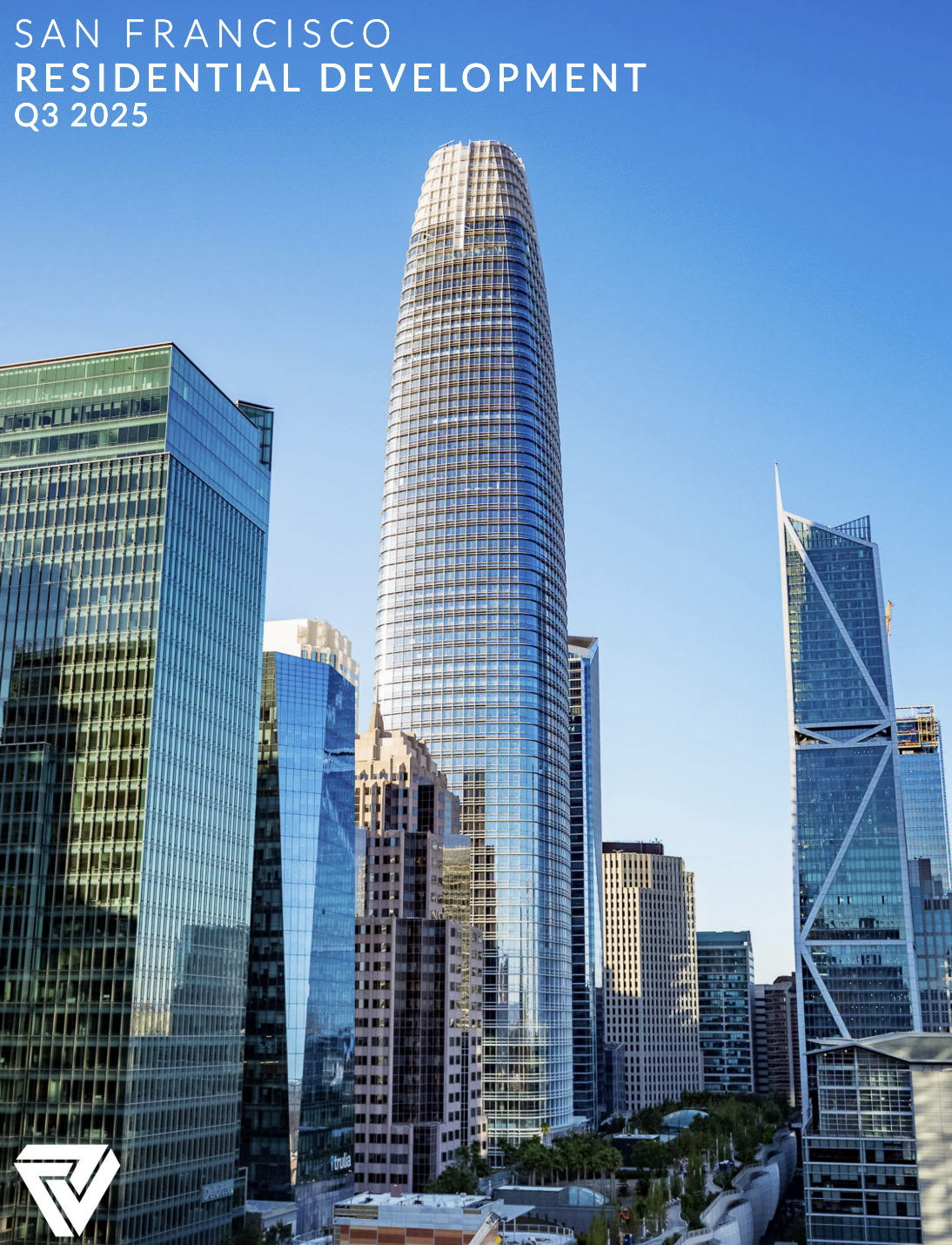
If you want to understand the emotional temperature of San Francisco real estate, look at new development. It’s the part of the market that reveals confidence or hesitation long before the resale market adjusts. And this quarter, there was movement that finally felt like The City exhaling after a long, uneven recovery. In fact, the latest findings in the Q3 2025 San Francisco Residential Development Report provide one of the clearest snapshots we’ve had in years of how buyers are behaving and where demand is gathering.
The simplest headline is this: buyers are choosing new construction again. Not in a speculative, early-cycle rush, but in a measured way that reflects what people want their lives to look like for the next decade. New condos jumped fifteen percent year over year, while resales slipped slightly. That gap isn’t an accident. It’s a reflection of what buyers value right now: cleaner design, better efficiency, predictable HOA structures, modern amenities, and the feeling of stepping into a home that supports the next version of themselves rather than the previous owner’s chapter.
Across the city, a handful of developments hit meaningful milestones. Some reached the halfway mark in sales, others released long-awaited units, and a few wrapped up entirely. Each one tells its own story about who is buying and where the energy is flowing.
• Norvoir — 915 North Point Street, Russian Hill: Now about halfway sold, this boutique building continues to attract buyers who want something intimate, well-finished, and rooted in a quieter part of The City. Its pace is a reminder that smaller buildings with thoughtful amenities still resonate deeply.
• The Belvedere — 2525 Van Ness Avenue, Cow Hollow: Now officially sold out. Proof that well-executed luxury in a neighborhood with built-in desirability has no trouble finding its audience, even in a recovering market.
• 350 San Jose — 350 San Jose Avenue, Noe Valley: With new active units released, this building is drawing buyers who want Noe Valley charm without the unpredictability of older housing stock.
• Renou — 988 Harrison Street, SoMa: Continued absorption signals that entry-level and mid-market buyers still see value in SoMa when pricing aligns with expectations.
• Four Seasons Private Residences — 706 Mission Street, Yerba Buena: Approximately 38 percent sold and continuing to move, reminding everyone that true luxury never disappears. It simply shifts with the economy.
Large-scale towers also continue to demonstrate that the upper end of the market is alive and well. One Steuart Lane, 181 Fremont, Crescent, The Avery, and other skyline-defining projects are closing at prices that would have seemed improbable a few years ago. Buyers willing to commit at two to four thousand dollars per square foot are not doing it impulsively. They’re choosing buildings that offer lifestyle, service, architecture, and identity. It’s not a flex. It’s alignment.
Meanwhile, the mid-market tier is doing the quiet work of keeping the city accessible to people who want new finishes and reliable systems without the full luxury premium. Buildings like Serif — 960 Market Street, 1288 Howard — 1288 Howard Street, and Maison a SoMa — 230 7th Street are trading in the nine-hundreds to low twelve-hundreds per square foot, giving first-time buyers, downsizers, and investors a real foothold. These projects matter because they shape the experience of people who want a modern home without feeling stretched past comfort.
Dogpatch, Mission Bay, and Potrero Hill continue to be the gravitational center for buyers seeking modern living near the bay. Whether it’s 2177 Third — 2177 3rd Street, 950 Tennessee — 950 Tennessee Street, 88 at the Park — 88 Arkansas Street, or the emerging pipeline around Pier 70, these neighborhoods tell a clear story: people want light, air, walkability, and a sense of newness that still feels connected to The City.
And then there’s the pipeline itself. On paper, San Francisco has thousands of units planned or approved. In reality, many of these projects are years away. Some have no sales date. Some are stalled. Some will need a different economic climate to come to life. Which means the current supply of new development is not being meaningfully replaced. For buyers, that scarcity matters. For developers, it creates a rare window. For the market, it suggests that today’s well-built buildings will likely age into strong long-term assets because there simply will not be enough new product to dilute them.
The price tiers in this report underline the theme. Homes under one million saw strong appreciation and faster sales. The one-to-two million range followed closely. The two-to-three million tier jumped almost nine percent. And the three-million-plus category is the most revealing. Nearly twenty percent appreciation and triple the number of sales year over year. Wealthy buyers may pause, but they rarely retreat.
All of this paints a clear picture. The City is not racing back. It is rebuilding itself with intention. And buyers are responding to homes that offer clarity, comfort, beauty, and stability. New development is doing exactly what it should in a city like ours. Reflecting who we are becoming, not just who we were before.
If you want help making sense of this segment of the market and where opportunity actually lives, reach out. This is the side of San Francisco real estate I study obsessively, and I’m always happy to walk you through how these numbers translate into real-world choices.