From Emporium to Westfield to Whatever’s Next: San Francisco Centre’s Next Act
The Westfield site has lived three distinct lives in my lifetime, even if the address never changed.
First came the Emporium era, the version that still feels like a childhood artifact. Every December, the rooftop Christmas setup took over the top of the building. It was not subtle. Lights, oversized displays, and a whole "this is happening now" feeling made downtown feel safe and special for families. I was so young that I am not sure whether I am imagining a tiny ferris wheel or whether that part is wishful thinking (the whole thing smelled like winter coats and whatever candy someone had bought five minutes earlier). It was a ritual. It also anchored the idea that going downtown was an outing, not an errand.
Then came my early-90s version, when cutting class from Lowell usually landed us at Stonestown. But when you cut as much class as I did, and Stonestown got boring, we would end up downtown instead. By that point, it was already a modern mall with Nordstrom and escalators that felt like a theme park. It was called the San Francisco Shopping Centre before Westfield’s name was on it, and it had that particular teenage magic of being both anonymous and strangely glamorous. You could disappear into it for hours without spending money, and you still felt like you were in the middle of The City.
The third life is the one everyone knows now... the Westfield San Francisco Centre era, glossy and expanded, and then slowly hollowed out. The building did not collapse. But for some reason, its soul did. The last occupants finally left, the bank took over, and the property was sold.
Now, it seems that Presidio Bay Ventures and Prado Group are the developers most likely to reshape what comes next, and this is where I stopped taking the headlines at face value and started looking at their actual work. Full disclaimer... this is not inside information. It’s pattern recognition thanks to my gift of ADHD and my love of exploring rabbit holes and potential outcomes, and it’s very much speculation based on what Presidio Bay Ventures and Prado Group tend to build when they have the chance.
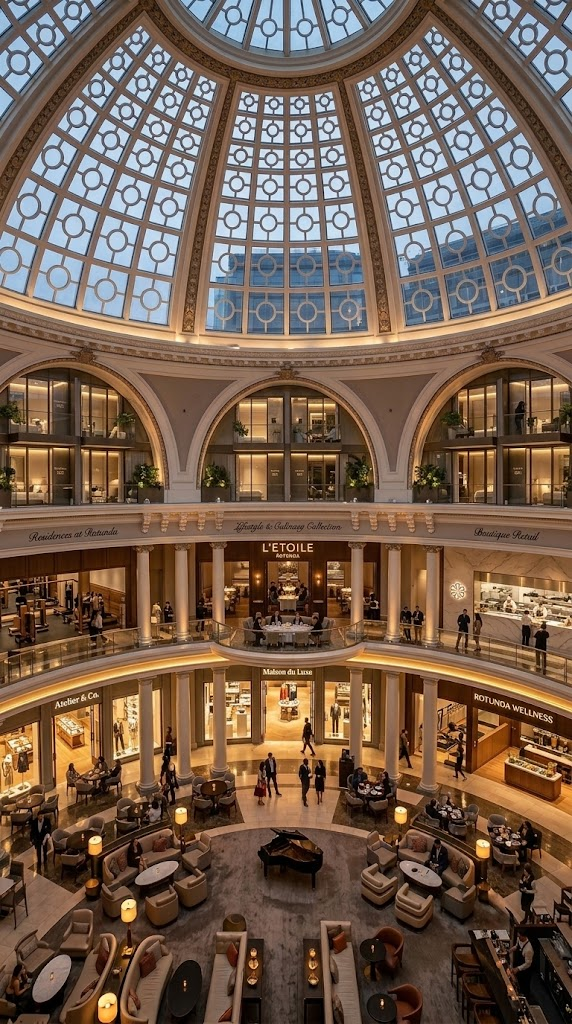
So what might replace the Westfield San Francisco Centre if it stops being a mall? If their past projects are any clue, it might turn into something closer to a vertical little neighborhood that happens to be indoors. Based on the developers’ history of hospitality-forward projects, the building will likely transition into a vertical neighborhood where wellness clubs, curated food halls, and luxury residential units replace traditional department store footprints. Not "shopping," more like "spend time."
I can picture the dome and rotunda becoming the building’s living room again, a place you head to on purpose. Not because you need socks, but because there’s a reason to be there. Winter events. A real holiday moment that feels like San Francisco, not a generic seasonal installation built to sell ornaments. (I want that rooftop energy back, but updated and a lot less sticky.)
I can picture food that feels curated instead of apologetic. The kind of lineup where you text a friend, not because you’re trapped at the mall, but because you want to meet for something good. A food hall could work, a market could work, a few chef-led spots could work, but the common thread is that it has to be a destination, not a basement compromise.
I can picture a high-end wellness anchor that makes the building feel alive before 10 a.m. and after 6 p.m. Not a sleepy gym. More like a clubhouse with lighting that makes everyone look slightly better than they do in real life.
I can picture the upper floors becoming homes, the kind that lean into the weird romance of living right in the middle of The City. High ceilings, dramatic light, and an address that only makes sense if you genuinely like city life and have a strong relationship with noise-canceling headphones.
I can picture offices that don’t feel like offices. Presidio Bay has leaned into hospitality-style workspaces in other projects, so I wouldn't be shocked if there’s a version of this where the "office" floors feel more like a members club with conference rooms than a fluorescent maze.
And yes, I can picture a return of real luxury retail, but in a tighter, more edited way. A few serious watch brands. Omega, Tudor, maybe even a larger Patek Philippe presence. Fashion that looks intentional, like Loewe, plus a few modern labels like Jacquemus, The Row, Khaite, and Toteme, and furniture and design showrooms that feel grown-up.
None of this works if the blocks around it keep feeling like a fentanyl corridor. That’s not pearl-clutching, it’s operational reality. People don’t "shop through" chaos. They avoid it.
One more thread I’m watching, and it’s boring but it matters. San Francisco has been tweaking incentives to get big buildings reused and retrofitted downtown. I’m planning to look specifically at transfer tax angles and seismic-related programs, because sometimes that’s the quiet reason a deal like this pencils at all. Of course these programs shift so that may just be me reaching for a reason.
For now, I’m treating this as a fun, informed thought experiment based on the developers’ past work, not a promise, and not a press release. But it’s the first time in a while that this building feels like it could become something people choose, not something people pass through.
If you’re buying or selling anywhere that’s sensitive to "downtown energy," this is the kind of shift you want to track early. If you want a reality check on how it might affect values, neighborhood energy, and long-term demand in your specific pocket of The City, reach out before you write an offer or make a big timing decision based on headlines alone.