Flashback Friday: The Japanese Tea Garden and the Family ThatWas Forced to Leave It
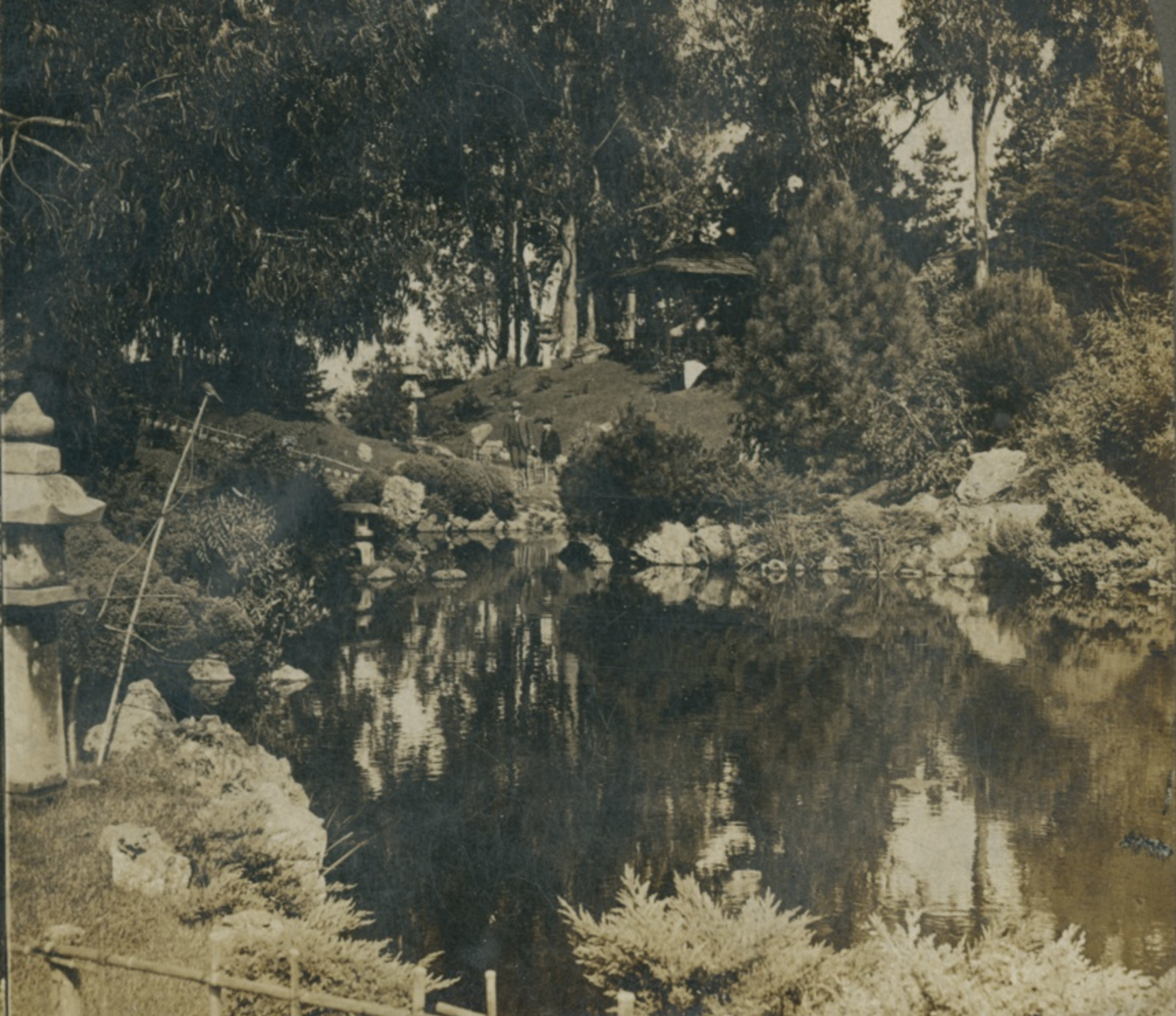
There's a pagoda in Golden Gate Park that most San Franciscans walk past without a second thought. It sits at the edge of the Japanese Tea Garden, surrounded by koi ponds and pruned pines, and on any given Saturday you'll find a line of tourists waiting to take photos in front of it. It's beautiful. It's peaceful. And it holds one of The City's quietest heartbreaks.
The Tea Garden started as an exhibit at the 1894 California Midwinter Fair... a temporary attraction built by an Australian art dealer named George Turner Marsh. When the fair closed, Marsh sold the exhibit to the city for $4,500 and hired a Japanese immigrant named Makoto Hagiwara to take care of it. Hagiwara was 40 years old. He'd come to San Francisco in 1878 when there were fewer than 100 Japanese people in the entire state of California.
What happened next is one of those stories that could only happen in San Francisco. Hagiwara didn't just maintain the garden. He transformed it. He imported plants and koi from Japan. He tripled its size. He built paths, ponds, a waterfall. He and his wife Tai moved into the second floor of the Nobleman's House (above the gift shop, naturally... this is San Francisco, after all) and raised their family there. He's also widely credited with introducing the fortune cookie to America, serving them to guests at the Tea Garden's teahouse.
Four generations of Hagiwaras eventually called that garden home.
Park superintendent John McLaren promised the family a 99-year agreement to live in and care for the garden. Makoto's daughter Takano and her husband Goro raised four children there. The kids grew up among the cherry trees and stone lanterns, in a 17-room house tucked behind the teahouse. They ran the concession, served tea, greeted visitors. The garden wasn't just their workplace. It was their home in the fullest sense of the word.
This wasn't the family's first brush with The City's uglier instincts. In 1900, Mayor James Phelan (who would later run for Senate on the slogan "Keep California White") pushed through a charter amendment barring anyone ineligible for citizenship from city employment. Because racist federal immigration laws prevented Japanese immigrants from becoming citizens, Hagiwara lost his job. The family was evicted. Makoto, stubborn and brilliant, set up a competing Japanese Village across the street on Lincoln Avenue. His way of telling the city exactly what he thought of their decision.
After the 1906 earthquake left Golden Gate Park in disarray, McLaren brought Hagiwara back. The family moved into the garden again. Makoto continued his work until his death in 1925, and the family carried on after him.
Then came 1942.
After Pearl Harbor, Executive Order 9066 authorized the forced removal of 120,000 Japanese Americans from the West Coast. The Hagiwara family... three generations of them... were sent to internment camps. George Hagiwara, Makoto's grandson, later testified that they left behind nearly $800,000 in property and possessions. Three generations of work. Gone.
The city didn't wait for them to come back. Officials razed the family's 17-room house. They tore down the Shinto shrine Makoto had installed. They renamed the space "The Oriental Tea Garden." They replaced the Japanese tea servers with Chinese women. They erased every trace of the family that had built the place.
When the Hagiwaras were released from the internment camps after the war, they hoped to resume managing their garden. The city refused. Despite McLaren's 99-year promise, despite three generations of care and investment, despite the fact that the Hagiwaras had literally built the Japanese Tea Garden into what it was... they were not allowed back.
The garden was renamed "Japanese Tea Garden" again in 1952. In 1953, Japan's Consul General presented a 9,000-pound Lantern of Peace, commissioned through small donations from Japanese children. It still stands in the garden today. A gesture of reconciliation in a place that had been the site of profound betrayal.
I think about the Hagiwaras every time I walk through Golden Gate Park. I think about what it means to build something beautiful in a place that doesn't always love you back. I think about the 17-room house that isn't there anymore, and the family photos that were probably inside it, and the cherry trees that Makoto planted with his own hands.
San Francisco is a city of layers. Every neighborhood, every block, every building carries stories that the current owners might never know. That's part of what draws me to real estate in The City... the understanding that when you buy a home here, you're not just buying square footage. You're becoming part of a story that started long before you arrived.
The Japanese Tea Garden is free to visit on Mondays, Wednesdays, and Fridays before 10 a.m. Go early. Walk slowly. And when you pass that pagoda, take a moment to think about the family that made it all possible... and what we took from them.
-
The Hagiwara family, led by Makoto Hagiwara, tended the Japanese Tea Garden in Golden Gate Park for four generations beginning in the 1890s. They were forcibly removed during WWII Japanese American internment in 1942 and never returned. The garden was renamed and the
family's home inside the garden was demolished.